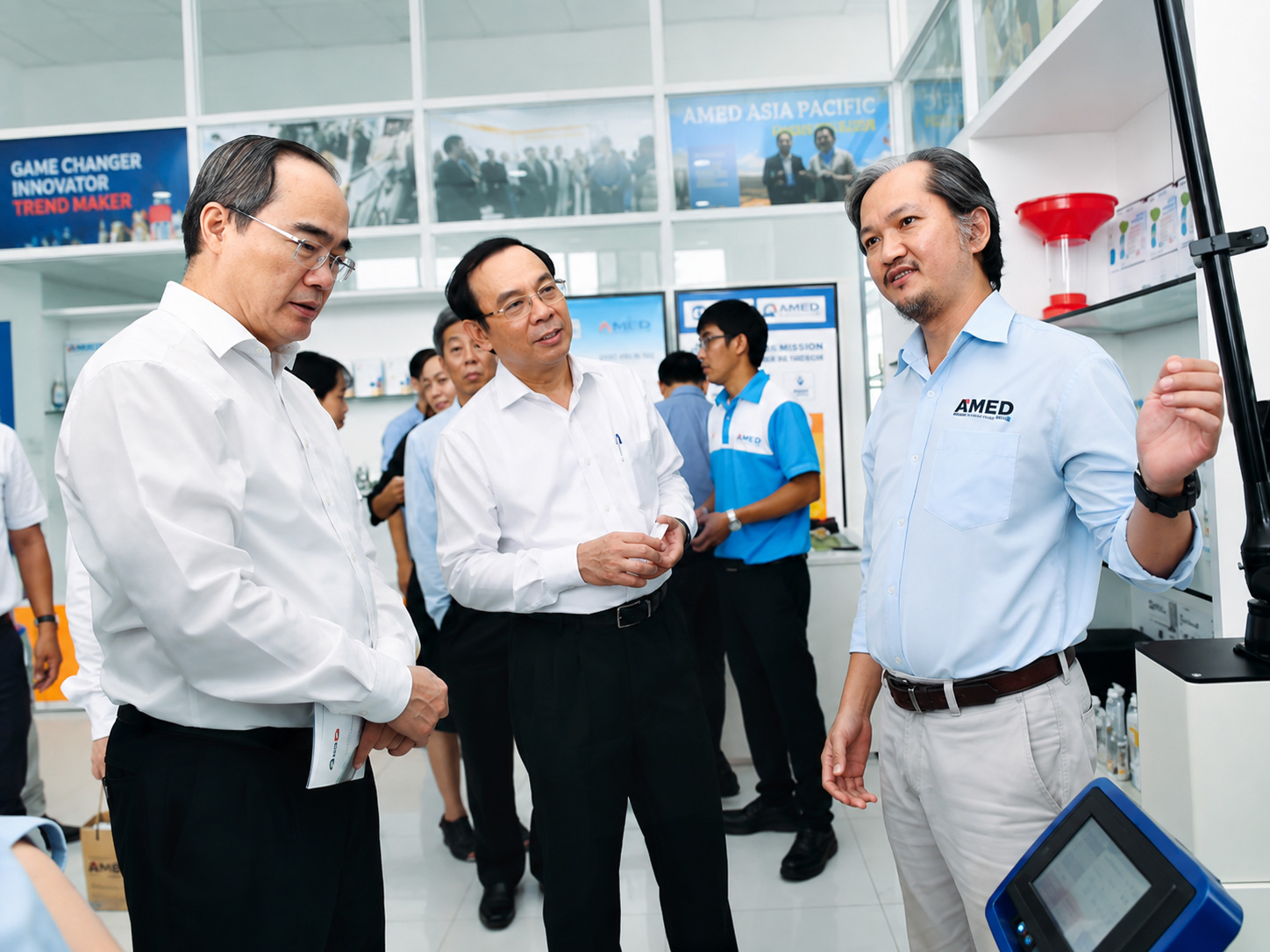
With years of experience developing laser and optical technologies in South Korea, engineer Luong Vu Dang Quang returned to Vietnam with a bold ambition: to build high-tech medical and aesthetic devices developed by Vietnamese engineers and make them competitive in both domestic and international markets.
From an Engineer in Vietnam to an R&D Leader in South Korea
Before establishing AMED, Luong Vu Dang Quang had already built a strong foundation in electronic engineering. He spent several years working for a US technology company in Vietnam, gaining practical experience in electronics and high-tech systems.
His career later took him to South Korea, where he joined a company specializing in the development of laser systems for medical and aesthetic applications.
Within a relatively short period, his technical expertise and ability to work across research and engineering teams led him to increasingly senior positions. After about one year, he became a department manager, and two years later he took on the role of R&D Director.
During seven years in South Korea, he was exposed to the full development cycle of advanced laser equipment, from technology research and engineering to manufacturing and international commercialization.
Why Return to Vietnam?
Working in South Korea gave Quang valuable access to advanced laser and optical technologies. At the same time, it also made him increasingly aware of a major opportunity in Vietnam.
Vietnamese engineers and technical professionals were contributing to the development of sophisticated technologies, yet many of the finished products were eventually introduced back into the Vietnamese market as imported equipment at significantly higher prices.
For Quang, this raised a fundamental question: Why could Vietnamese engineers not develop and manufacture their own high-tech products for Vietnamese customers and eventually for international markets?
He believed that the combination of local engineering talent, technology development, and domestic manufacturing could create products that were not only more accessible but also capable of competing beyond Vietnam.
That belief ultimately led him to make the difficult decision to leave his career in South Korea and return home.
Building a High-Tech Venture from the Ground Up
In 2016, Quang began developing the AMED project in Ho Chi Minh City, starting with a small research and manufacturing environment dedicated to laser systems for medical and aesthetic applications.
The transition was far from easy. Compared with the highly standardized manufacturing environment he had experienced in South Korea, Vietnam still faced challenges in maintaining consistent quality across components and suppliers.
Every element of a high-tech device—from electronic circuit boards to mechanical components—must meet strict technical requirements. Establishing a reliable manufacturing process therefore required AMED to build its own technical standards, supplier relationships, testing procedures, and quality controls.
The journey also required significant personal investment. For several years, Quang continued to invest his own capital into research, engineering, equipment, and production before the business began generating meaningful revenue.
The First Product: CO2 Fractional Laser
One of AMED’s first major technology milestones was the development of a CO2 fractional laser system for skin resurfacing and scar treatment.
The system was developed to support professional aesthetic applications, using controlled laser energy to create microscopic treatment zones within the skin. This fractional approach forms the technological basis for skin resurfacing procedures and applications targeting wrinkles and scars.
After completing development, the equipment was introduced into practical use, including at 108 Military Central Hospital in Hanoi.
For AMED, this represented more than the launch of a new product. It was proof that a Vietnamese engineering team could take a complex laser technology from research and development to a functioning product capable of being deployed in a professional healthcare environment.
From Vietnam to International Markets
AMED’s ambition was never limited to replacing imported equipment in Vietnam. From the beginning, the company also envisioned Vietnamese-developed technology reaching international customers.
Following the development of its laser systems, AMED products began reaching overseas markets through international manufacturing partnerships.
Some equipment was exported to the United States under customer brands, while other products were supplied to markets outside Vietnam, including South Korea.
This international activity demonstrated that products developed and manufactured in Vietnam could become part of a global supply chain rather than remaining exclusively within the domestic market.
Competitive Technology, More Accessible Cost
Developing technology locally also provides AMED with greater flexibility in product engineering, manufacturing, maintenance, and cost management.
By increasing local participation in the development and production process, AMED can reduce some of the costs associated with imported equipment while maintaining a strong focus on technical performance and usability.
For the Vietnamese market, this creates an opportunity to offer professional aesthetic laser equipment at a more accessible investment level compared with equivalent imported systems.
More importantly, local development enables AMED’s technical team to work directly with customers, understand practical requirements, and continuously improve equipment based on real-world feedback.
Expanding into Next-Generation Laser Solutions
Building on its experience with CO2 fractional laser technology, AMED continues to invest in research and development for additional aesthetic laser applications.
One of the company’s areas of focus is the development of laser systems for skin pigmentation applications, with the dual objective of improving technological capabilities and making professional equipment more accessible to the market.
These development efforts form part of a broader strategy to expand AMED’s portfolio of aesthetic medical devices while strengthening its ability to design and manufacture laser systems locally.
Looking Beyond Vietnam to Southeast Asia
AMED’s international vision extends beyond individual export orders. The company aims to gradually establish Vietnamese-developed laser technology in broader regional markets.
Southeast Asia represents an important opportunity, with growing demand for aesthetic medicine, professional skincare, and advanced treatment technologies.
AMED’s strategy is therefore built around developing products that combine technical capability, practical usability, competitive cost, and localized engineering support.
By strengthening these capabilities, the company aims to expand from a Vietnamese technology developer into a regional provider of aesthetic medical equipment.
Made in Vietnam, Built for the World
AMED’s journey began with a simple but ambitious belief: Vietnamese engineers can create high-tech products that are not only suitable for the domestic market but also competitive internationally.
The development of laser equipment has become a practical demonstration of that philosophy. From research and optical engineering to manufacturing, testing, deployment, and international partnerships, AMED continues to build capabilities across the technology development process.
What started as one engineer’s decision to return home has evolved into a broader mission—to transform Vietnamese engineering expertise into products that can serve customers in Vietnam and around the world.
Made in Vietnam is not simply where the product is manufactured. For AMED, it represents the capability to research, engineer, build, and continuously improve technology in Vietnam for a global market.


